
New to smart lockers? Start your journey here!
As the world places more demands on Earth’s finite resources, are there things we in the logistics industry can do to lessen our impact while providing higher levels of customer satisfaction? One of the biggest offenders is “last mile delivery.” Taking steps to improve delivery efficiency requires blue-sky thinking, inventive partnerships, and a genuine desire to change entrenched processes.
If you could take a time-lapse video of your entire neighbourhood over the course of a day from a 500-foot perch. From above, concentrate on the courier delivery vehicles coming and going. You would be amazed at the level of activity — different courier companies delivering parcels on the same street, multiple times a day. Each delivery person stops, rings the doorbell, runs back to the truck with parcel in hand (because no one is home), or leaves the package on the porch at the mercy of Porch Pirates, then motors on to the next location. Rinse and repeat.
What you witness is a massive web of courier fleets trying their best to keep up with the rapid rise of residential parcel delivery driven by the growth in e-commerce. As the day progresses, and from a higher vantage point, you’d notice the amount of traffic and sheer congestion that envelopes our neighbourhoods — especially in areas with a high density of apartments and condos.
Contrary to common perception, e-commerce has not alleviated the negative effect that consumer shopping has on the environment. It has actually added to it.
Twenty years ago, you’d hop in the car and drive from mall to mall before your purchases were complete. Now you research online, pick a product, and have it delivered. On the surface, online shopping appears more efficient. But the sheer number of deliveries made to a vast number of individual addresses has produced a net negative effect. According to a 2024 UN Digital Economy Report, e-commerce generates 4.8 times more packaging waste than goods sold in brick-and-mortar stores.
Approximately 161 billion parcels were shipped worldwide in 2022, and that number is expected to grow to 200 billion by the end of 2025 — increasing packaging waste concerns significantly. In Canada specifically, the courier and parcel delivery market is now valued at $18.4 billion CAD in 2025, and e-commerce revenue is projected to grow at 9.8% annually through 2029.
The “last mile” — the final leg from a delivery hub to your door — is the most carbon-intensive part of the journey. Last-mile delivery accounts for up to 40% of all e-commerce emissions, and forecasts indicate these emissions could increase by 60% by 2030. Meanwhile, carbon emissions from e-commerce logistics in major urban areas worldwide are forecast to reach approximately 25 million CO₂ metric tons by 2030.
Fast shipping compounds the problem. Today, 80% of consumers want their orders delivered within two days — and to meet those expectations, Amazon alone delivered over 9 billion same-day or next-day orders in 2024. Express shipping increases CO₂ emissions by up to 15% compared to standard delivery methods.
The environmental cost doesn’t end at delivery. Online returns contribute up to 24 million tonnes of CO₂ emissions annually, with return shipments generating approximately 30% more emissions than the initial delivery.
Online purchases have a return rate of 16%, significantly higher than the 9% rate for items bought in physical stores. The reverse logistics process costs the industry an estimated $890 billion annually. In 2022 alone, companies sent over 9.5 billion pounds of returned products directly to landfills because it was more cost-effective than reselling or refurbishing them. Those shoes you ordered in the wrong colour? They may not be going back on the shelf — they may be going into the ground.
Some big players in the e-commerce world have proposed novel alternatives: drone parcel delivery, and localized pickup hubs in convenience stores. With limited real-world use cases and significant regulatory hurdles, drone delivery remains largely theoretical. Convenience store hubs have seen little traction either. Neither addresses the fundamental problem: too many individual delivery attempts spread across too many addresses.
There is one solution that has demonstrated real success — first in Asia and Europe, and now increasingly in North America. It’s called the Smart Parcel Locker, and the idea is simple. Located in convenient urban centres and in the lobbies of multi-unit residential buildings, these lockers provide a centralized drop-off point for couriers while enabling residents to pick up their parcels whenever it’s convenient for them.
It saves time and fuel for couriers who no longer need to navigate to each individual unit. It eliminates failed delivery attempts — a major source of repeat trips and wasted emissions. And it simplifies the return process: residents drop off return items at the same locker, consolidating reverse logistics in one location.
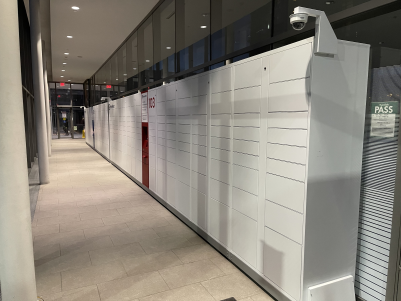 A 292-slot residential Parcel Locker Serving 1,500 residents.
AI-powered route optimization alone can reduce the number of delivery vehicles on the road by up to 60% and cut delivery times by 27%. Customcy Smart locker networks take this further by reducing the total number of stops required — one locker serves an entire building rather than every individual unit.
Consider the math: if just 10% of residential parcel deliveries were routed through a smart locker network, the reduction in courier trips, fuel consumption, and failed delivery attempts would be substantial — saving millions of hours of driver time annually and meaningfully cutting urban traffic congestion.
Parcel lockers are also open 24/7, allowing couriers to make deliveries outside of peak hours — taking advantage of lower traffic volumes and reducing congestion on neighbourhood streets during rush hour.
Like every courier, you’re facing rising last-mile delivery costs and consumers looking for less expensive, more convenient shipping alternatives. You also operate in a world increasingly focused on lowering the environmental impact of e-commerce. Here’s how embracing smart parcel lockers helps:
Collaborate with companies building open networks of standardized smart parcel lockers. Experiment and pilot solutions that directly target your last-mile delivery costs. Offer the solution as a single, cost-effective alternative to better serve your retail partners and their customers. The greater the adoption, the more savings — and the lower the emissions — you should realize.
E-commerce is not slowing down. Global e-commerce sales by businesses grew to USD 27 trillion in 2022 International Institute for Sustainable Development, and the growth trajectory continues. But the environmental cost of convenience is becoming impossible to ignore. The good news is that smart locker infrastructure directly addresses the problem at its source — reducing the number of individual delivery attempts, consolidating returns, and enabling more efficient courier routing.
Here at ParcelPort, we’re passionate about a future that includes a network of Smart Parcel Lockers given their potential to positively impact couriers, consumers, businesses, and our environment. It’s a cleaner alternative that checks all the boxes.
To learn more about how your organization can reduce delivery costs, lower your environmental footprint, and delight your residents or customers, contact the ParcelPort team at theparcelport.com or call 1-800-818-0870.
